

Firme Friday: Mark Guerrero, Son of Lalo Guerrero
“Chicanos and Chicanas and East LA artists have always moved with the times,” Mark explained.

JOIN TODAY and get 10% off your Daily Chela Insider subscription for an entire year.

I had the pleasure of interviewing the legendary Chicano Rock and East LA Sound pioneer, Mark Guerrero, in April of 2024. Mark is the son of the legendary Lalo Guerrero, the “father of Chicano music.”
By 13, he was performing with his band, Mark & the Escorts, sharing bills with East LA legends like Cannibal & the Headhunters, The Premiers, The Blendells, Thee Midniters, Thee Ambertones, and many, many more. The group also recorded two singles in 1965, “Get Your Baby” and “Dance With Me,” helping define the emerging East L.A. sound. He came up with these bands, and they all made their bones together.
Guerrero continued to evolve with the scene, later leading the Men From S.O.U.N.D. and Nineteen Eighty-Four, before launching his solo career with “Lila, Love Me Tonight,” produced by Lou Adler. He followed that with Capitol Records singles like “Rock & Roll Queen” and “I’m Brown,” and later formed Tango, whose early ’70s recordings would later gain renewed recognition as part of the Chicano rock canon.
In this conversation, Guerrero reflects on that trajectory—on the eras he lived through, the shifts in sound, and how Chicano artists have continued to evolve across decades.
When I asked him if he stayed up to date on new Latino bands, Mark mentioned artists like Chicano Batman and Thee Sinseers. He noted that while there are many different genres now, that variety is exactly what makes him proud of the community.
To Mark, the story of East LA music is one of constant survival through adaptation. “Chicanos and Chicanas and East LA artists have always moved with the times,” he explained.
He traced a direct lineage from his own era in the 60s and 70s into the punk movement that followed, noting how bands like Los Illegals and The Brat proved the neighborhood’s sound couldn’t be boxed in. From artists playing cumbias and jazz to modern acts like La Santa Cecilia, Mark sees a relentless creative drive. “We’ve gone through all these genres,” he said, “and we continue to evolve.”
However, Mark was candid about how today’s industry stacks up against the era he helped define. As we discussed the current state of pop, he admitted to a certain prejudice for the late 60s and early 70s. “I think that is the greatest period for rock and pop music,” he said. “The greatest artists, the greatest records, and the greatest songs were in that period.”
While he acknowledges that you’ll still find the occasional great song or a really talented artist today, he feels the sheer volume of brilliance from the 20th century remains untouchable. He argued that he could list 100 artists from that time who simply don’t have a modern equivalent. “Generally speaking, if you look at the charts, man, it’s pretty bleak,” he added.
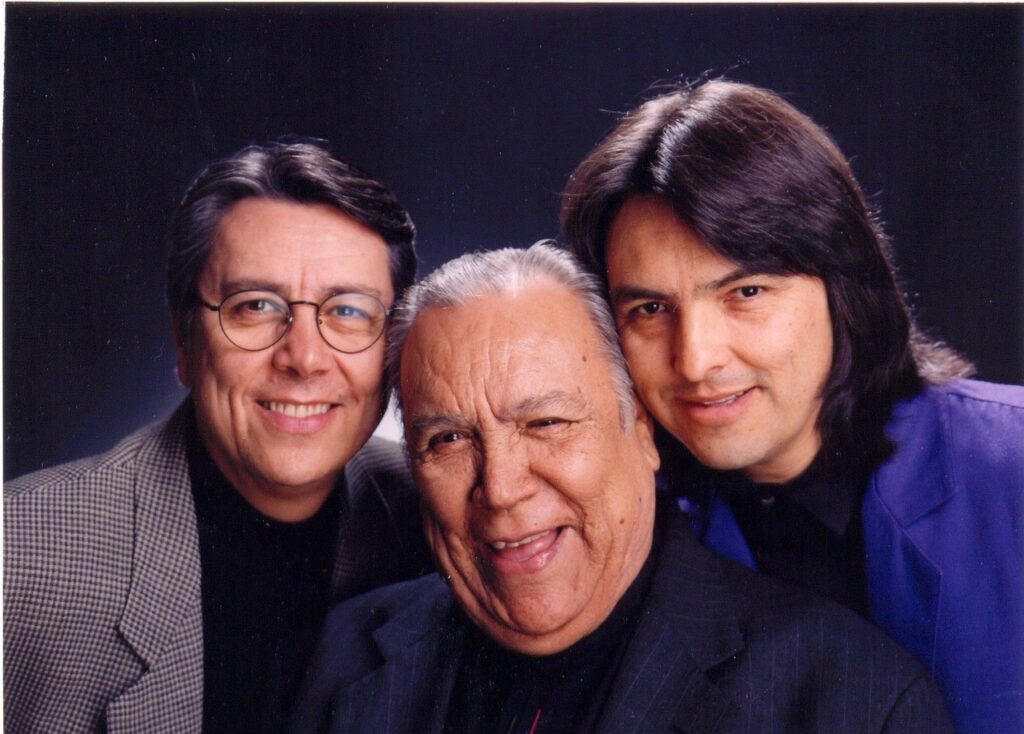
Despite his critique of the mainstream, Mark’s outlook for the local scene remains optimistic. He ended our conversation by returning to the talent still emerging from the community. Even if the industry at large feels lackluster to him, he knows the heart of the movement hasn’t stopped beating. “A lot of Chicanos,” he reminded me, “are still making good music.” It is a sentiment that resonates deeply with me when looking at the current music scene.
There is a new wave of bands keeping that spirit alive and well, proving that the foundation laid by previous generations is being built upon with incredible fervor. Bands like Barrio Slam, a Chicano hardcore outfit, directly evoke the themes of the Chicano Movement through powerful tracks such as “Aztec Blood,” “Xicano Hardcore,” and “Brown Pride World.”
Meanwhile, the indie-alternative group Chicano Mosh and the psychedelic cumbia punk band Tropa Magica offer sounds that feel hauntingly familiar yet entirely groundbreaking.
The reach of this modern movement extends to the Tex-Mex punk rock of Piñata Protest, which is currently bringing its high-energy accordion riffs to a national audience on tour with Reverend Horton Heat. Rounding out this resurgence is a great band I saw a month ago, The Killing Floors, a Chicano rock and roll band keeping the sound and style of 60s garage rock alive and well.
All of these artists are doing more than just playing notes; they are preserving a proud legacy. By blending the historical weight of their predecessors with contemporary innovation, they ensure that the Chicano musical identity remains a powerful, evolving force. It is a joyful realization to see that the torch has not only been passed but is burning brighter than ever, fueled by a new generation that continues to create great, meaningful music with undeniable pride.
Sammy blends sociology with hands-on experience in music research, documentary filmmaking, and journalism. With a talent for in-depth research and a knack for finding compelling narratives, he aims to shed light on stories that resonate and reveal the pulse of societal change. He also brings a unique sociological perspective to all things pop culture.
JOIN TODAY & Get 10% Off A Daily Chela Insider Subscription For A Year!

Please Support Independent Media
Our mission is to tell stories the mainstream media ignores, provide fearless reporting, and offer independent analysis.
But we can’t do this without you!
Together, we can make sure that every voice is heard and every story is told.